Math ABC - Discrete Functions 02
Fibonacci Sequence
In a sequence, each number after the first 2 numbers, is the sum of the preceding 2 numbers.
1, 1, 2, 3, 5, 8, ... is Fibonacci sequence.
Fibonacci sequnce can be from using 1 unit square's side to draw another square (2 squares now creates a rectangle), then use the 2 units side to draw the 3rd square... the shorter side of all rectangle's lengthes (the 1st is a square) are just the Fibonacci Sequence.
Pascal's Triangle
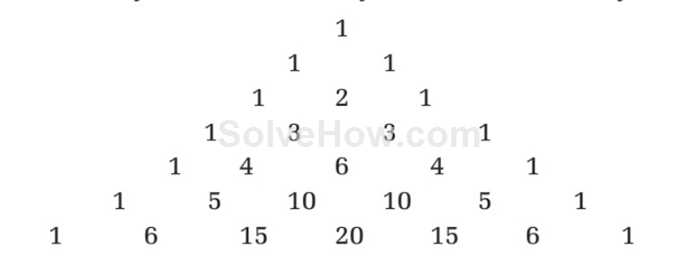
Expand a power of a binomial:
(a + b)¹ -> row0: (1 + 1)¹

(a + b)² -> row1: (1 + 1)²

(a + b)³ -> row2: (1 + 1)³

(a + b)⁴ -> row3: (1 + 1)⁴
Arithmetic Sequence
In a sequence, a constant is added to each term to get the next term, this is an Arithmetic sequence.
Arithmetic Sequence Common difference:
The difference between consecutive terms in an arithmetic sequence.
Formula of Arithmetic Sequence:
 tn = a + (n-1)d

 (tn is the n(th) term, a is the first term,  d is the common difference,  n is the term number)
Geometric Sequence
In a sequence, the ratio of consecutive terms is a constant, the sequence is called Geometric Sequence.
Geometric Sequence Common difference:
The ratio of consecutive terms of a geometric sequence.
Formula of Geometric Sequence:
 tn = a(r)^(n-1)

 (tn is the n(th) term, a is the first term, r is the common ratio, n is the term number)
Read Also:
There are total 2 posts about Discrete Functions:
Math ABC - Discrete Functions 01
Search
Categories
Share
Site QR Code